
In specialty chemical manufacturing, scale-up is where theory meets reality.
A reaction that behaves predictably in a lab setting can shift significantly when exposed to larger volumes, different mixing dynamics, and real-world variability. At this stage, success rarely hinges on chemistry alone. It depends on the alignment of three critical elements:
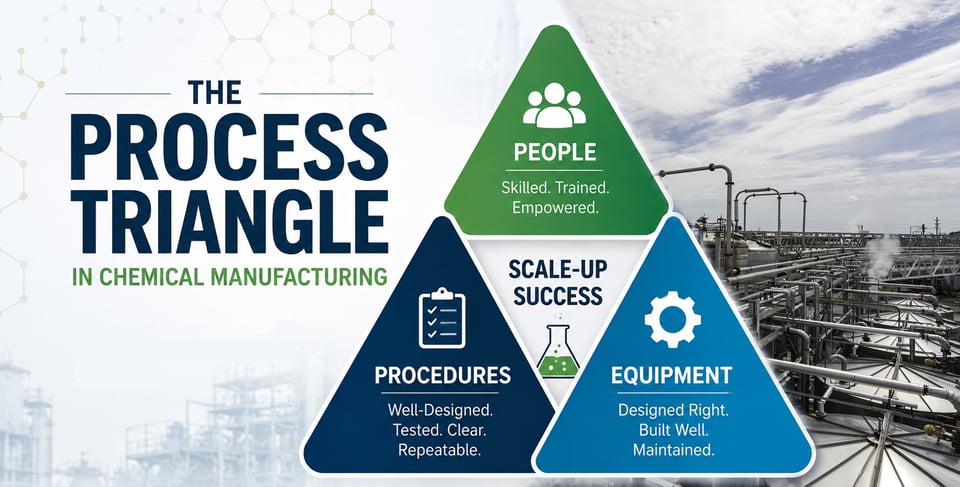
People. Procedures. Equipment.
Think of it as a process triangle. When all three are aligned, scale-up becomes predictable. When one is weak, even well-designed chemistry can struggle.
1. People: Experience, Training, and Judgment Under Real Conditions
At scale, operators are not just executing instructions. They are actively managing a system that can evolve in real time.
Well-trained personnel understand:
- What “normal” looks like for a process
- How small deviations can signal larger issues
- When to intervene and when to observe
Training is not limited to initial onboarding. It is reinforced through:
- Exposure to multiple campaigns and chemistries
- Cross-functional communication with engineering and QC
- Understanding the intent behind the process, not just the steps
In practice, this is where experience matters.
It is not uncommon to encounter a situation where something feels slightly off, even when parameters appear within range. Often, that instinct is informed by prior runs, edge cases, or lessons learned years earlier.
Sometimes, it traces all the way back to a concept first introduced in a university lecture. Reaction kinetics, heat transfer limitations, or mass transfer constraints do not disappear at scale. They become more relevant.
2. Procedures: Tested, Clear, and Built for Real Execution
A procedure should do more than document a process. It should enable consistent execution under real manufacturing conditions.
Effective procedures are:
- Validated through testing, not just theoretical design
- Structured for clarity, so operators can follow them without ambiguity
- Adaptable, with defined ranges and decision points
One of the most common failure points in scale-up is not the chemistry itself, but the translation of that chemistry into an executable procedure.
A strong procedure anticipates:
- Variability in raw materials
- Environmental influences
- Equipment-specific differences
- Likely failure modes
It also answers practical questions:
- What should the operator do if a temperature overshoots?
- What is the acceptable range for addition rates?
- When should the batch be paused or adjusted?
Clarity is critical. In a manufacturing environment, procedures must be actionable, not interpretive.
3. Equipment: Designed, Built, and Maintained for the Process
Equipment is often viewed as a constraint. In reality, when properly aligned, it enables the process.
The goal is not always to introduce new equipment. In fact, during scale-up, one of the most efficient outcomes is being able to say:
“We can run this with existing assets.”
That outcome depends on:
- Reactor design compatibility
- Adequate mixing and heat transfer capability
- Materials of construction
- Instrumentation and control systems
Even well-designed equipment must be:
- Properly maintained
- Calibrated and validated
- Understood in terms of its limitations
At scale, small equipment mismatches can amplify into process variability. Conversely, well-matched equipment can stabilize even complex chemistries.
Understanding the Process: The Connecting Thread
People, procedures, and equipment do not operate independently. They are connected by one critical factor:
Process understanding through comprehensive training.
This includes:
- Knowing how the reaction behaves under different conditions
- Anticipating how scale changes those behaviors
- Identifying where variability is most likely to occur
Just as importantly, it includes recognizing what is not fully understood.
Some aspects of a process only become clear through execution. Not every variable can be predicted in advance. This is why iterative learning remains a core part of successful scale-up.
Planning defines the path.
Execution reveals the terrain.
Anticipating What Can Go Wrong—and Planning for It
Reliable processes are not defined by the absence of problems. They are defined by preparedness.
Strong scale-up strategies include:
- Predefined responses to deviations
- Clear escalation pathways
- Real-time monitoring of critical parameters
- Feedback loops between operations, engineering, and quality
In practice, this means asking:
- Where is the process most sensitive?
- What is the most likely failure mode?
- How quickly can we detect and correct it?
When these questions are addressed early, scale-up becomes more controlled and less reactive.
Global Reach with Regional Accountability
While Ethox is well known in the Southeast United States, our capabilities serve customers worldwide.
As part of the Syntha Group family of brands—founded in 1938—we combine the stability of a multi-generational organization with the flexibility of a privately held company.
This structure allows us to:
- Make decisions efficiently
- Prioritize long-term partnerships over quarterly optics
- Invest in innovative chemistries
- Maintain direct, transparent communication
You gain the reliability of an established manufacturer without the bureaucracy of a multinational conglomerate.
Where Scale-Up Succeeds
Successful scale-up is not a single milestone. It is the result of alignment:
- People who understand both the process and its intent
- Procedures that translate chemistry into consistent execution
- Equipment that supports performance without introducing instability
When those elements come together, confidence follows. Not because the process is simple, but because it is understood.
Ethox Excels at Chemical Process Scale-Up
If you are evaluating a process for scale-up or troubleshooting variability in an existing system, alignment across people, procedures, and equipment is often the starting point.
Connect with Ethox’s process engineering team to discuss your manufacturing challenges.